Introduction
Missed bill payments damage your credit score, trigger late fees, and create mental clutter. Yet millions of people still rely on memory to pay bills – a system that fails eventually. The solution is automation: setting up payments so they happen without your intervention. This guide explains how to set up Direct Debits and standing orders for all regular bills, how to organise your accounts to prevent overdrafts, and how to handle irregular bills. The goal is a system that runs itself, requiring only occasional monitoring.
Based on rules as of January 2026. Always verify current rates with official sources.
The Two Types of Automatic Payments (Recap)
From article 5, recall the distinction:
Direct Debit – The billing company pulls money from your account. Amounts can vary. Protected by the Direct Debit Guarantee. Best for: utilities, council tax, insurance, subscriptions, credit card minimum payments.
Standing order – You push money to a recipient. Amounts are fixed. No protection. Best for: rent to a private landlord, transfers to savings accounts, fixed charitable donations.
Which to use for bills: Use Direct Debit wherever possible. It offers protection and automatically adjusts to the correct amount. Use standing orders only when the recipient does not support Direct Debit (e.g., a private landlord) or when you want fixed, predictable transfers (e.g., to savings).
The Bills Account System
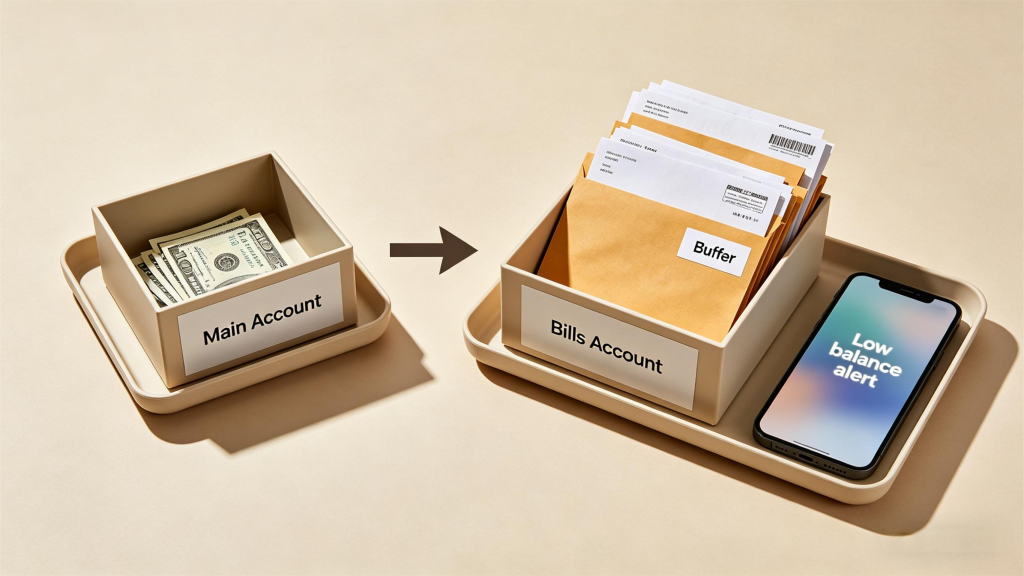
The single most effective technique for avoiding missed payments and overdrafts is the bills account.
How it works:
- Open a separate current account (free) – ideally with a different bank from your main account, but the same bank works.
- Do not keep a debit card for this account, or keep it in a drawer at home.
- List all your regular bills (rent/mortgage, council tax, utilities, insurance, subscriptions, credit card minimums).
- Calculate the total monthly amount, plus a small buffer (e.g., £50).
- Set up a standing order from your main current account to the bills account, scheduled for the day after payday, for the total amount.
- Set up Direct Debits and standing orders for all bills from the bills account.
Why it works:
- Your bills account always has enough money to cover payments because you fund it first.
- You never accidentally spend bill money on discretionary purchases (because you do not carry the debit card).
- If a bill is higher than expected (e.g., winter energy bill), the buffer absorbs the difference. If the buffer runs low, you top it up manually.
- Your main account shows only your spending money – clearer budgeting.
Example: Your bills total £1,200 per month. You add a £50 buffer. Standing order = £1,250 on the 2nd of each month (after your 1st-of-month payday). The bills account pays council tax (£150), energy (£100 average), water (£40), broadband (£30), insurance (£60), and so on. You never think about bill due dates.
Setting Up Direct Debits for Every Eligible Bill
If a bill can be paid by Direct Debit, use it. Here is how to set them up:
Council tax: Contact your local council (online or phone). Provide your bank account number and sort code. Choose a payment date (typically 1st or 15th of the month). Most councils spread payments over 10 months (April–January) but offer 12-month spreading on request.
Utilities (gas, electricity, water): Provide your bank details through your supplier’s website or app. Most offer monthly Direct Debit based on estimated annual usage. Submit regular meter readings to ensure accurate billing.
Broadband, mobile, TV licence: Set up through your provider’s account portal.
Insurance (home, car, life): Most insurers offer a discount (typically 5–10%) for paying by Direct Debit rather than annually. However, paying annually is often cheaper overall because you avoid monthly interest charges. Compare: annual payment vs monthly Direct Debit total cost.
Credit cards: Set up a Direct Debit for at least the minimum payment. Better: set it for the “full balance” or “fixed amount” that clears the balance each month.
Subscriptions (Netflix, Spotify, gym): Use Direct Debit or recurring card payment. Note that recurring card payments are not protected by the Direct Debit Guarantee – they are treated like standing orders. Where possible, use Direct Debit.
Handling Bills That Cannot Be Automated
Some bills cannot be automated or are irregular.
Annual bills (car tax, MOT, home insurance renewal): These are predictable in timing but not in amount. Add them to your bills account calculation by dividing the annual cost by 12 and including that amount in your monthly transfer. When the bill arrives, pay it from the bills account.
Example: Car tax = £180 per year. Add £15 per month to your bills account transfer. In month 12, the bills account has accumulated £180 (plus buffer) to pay the tax.
Irregular bills (dental treatment, car repair, vet bill): These are not predictable. They should come from your emergency fund, not your bills account. If you use your emergency fund, replenish it as a priority.
Payments to individuals (cleaner, childminder, gardener): Use a standing order if the amount is fixed and regular. If the amount varies, use bank transfer (manual) or ask if they can set up a Direct Debit (unlikely for individuals).
Avoiding Overdrafts: The Buffer and Alerts
Even with a bills account, overdrafts can happen if your main account runs low before payday.
The buffer: Keep a minimum balance in your main account – typically £200–£500. Treat this as zero. If your balance drops to £300 and your buffer is £200, you have £100 of spendable money. This prevents accidental overdrafts from small miscalculations.
Low balance alerts: Most banking apps allow you to set a notification when your balance falls below a threshold (e.g., £100). Set this alert. When you receive it, log in and transfer money from savings or reduce spending.
Overdraft as a last resort: If you have an arranged overdraft, it can serve as a buffer. But interest accrues. Better to keep actual cash.
If you frequently dip into overdraft: Your spending exceeds your income. Review your budget (article 1) and reduce discretionary spending or increase income. An overdraft is a symptom, not the problem.
Monitoring Your Automated System
Automation is not “set and forget.” It requires occasional monitoring to catch errors and changes.
Weekly check (5 minutes):
- Log into your bills account. Confirm that all Direct Debits have been paid (no returned payments).
- Check your main account balance. Is it above your buffer?
- Scan for unauthorised transactions.
Monthly check (10 minutes, after payday):
- Confirm the standing order to your bills account has executed.
- Review the bills account statement. Are any bills higher than expected? If so, adjust your monthly transfer amount.
Annual check (30 minutes):
- Review all Direct Debits. Are you still using all the services? Cancel unused subscriptions.
- Update bill estimates (e.g., energy usage may have changed).
- Consider whether any bills could be reduced by switching providers (insurance, broadband, mobile).
What to Do When a Direct Debit Fails
Sometimes a Direct Debit fails – insufficient funds, bank error, or the billing company’s error.
If the failure is due to insufficient funds: Transfer money to the bills account immediately. Contact the billing company to arrange a manual payment. Ask if they will waive any late fee (they often do for a first offence). Set a reminder to increase your bills account buffer.
If the failure is due to bank error: Contact your bank. Under the Direct Debit Guarantee, they must correct the error and cover any resulting costs (late fees, interest charges).
If the failure is due to billing company error: Contact the billing company. They should correct the error and waive any fees. If they do not, ask your bank to reverse the failed payment under the Direct Debit Guarantee.
To prevent future failures: Increase your bills account buffer. If your bills are £1,200 per month, a £200 buffer (rather than £50) gives more breathing room.
The Role of the Emergency Fund in Bill Management
Your emergency fund (3–6 months of expenses) is not for regular bills. But it serves as a backstop for the bills account system.
If your bills account runs out of money (e.g., because of an unexpectedly high energy bill and a simultaneous annual insurance renewal), you can transfer money from your emergency fund to cover the shortfall. Then replenish the emergency fund over the next few months.
If you lose your job: Your emergency fund should cover bills for 3–6 months. In this scenario, you would manually transfer from the emergency fund to the bills account each month.
Do not keep your emergency fund in your bills account – that would make it too easy to spend. Keep it in a separate savings account, ideally at a different bank, not linked to a debit card.
Key Takeaways
- Open a separate bills account – fund it from your main account on payday, pay all bills from it.
- Use Direct Debit for every eligible bill – protection and automation.
- Include a buffer (£50–£200) – prevents failed payments from small miscalculations.
- Set up low-balance alerts – avoid accidental overdrafts.
- Monitor weekly and monthly – automation still needs oversight.
This article is for general information and educational purposes only. It does not constitute financial advice. Tax rules, allowances, and product terms may change. Always check with HMRC or an FCA-authorised adviser for your personal circumstances.