Introduction
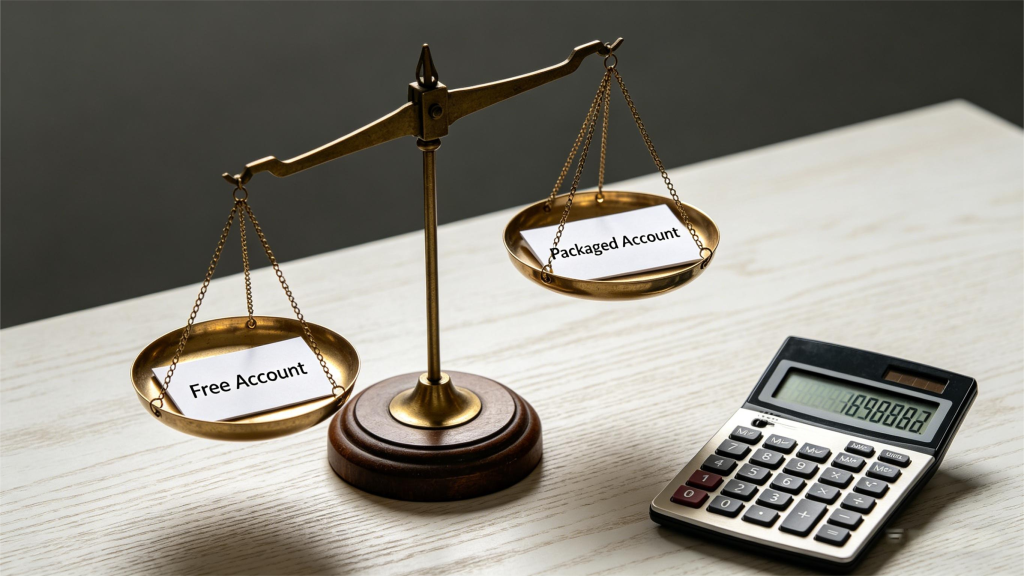
Free banking has been the norm in the UK for decades. Most current accounts charge no monthly fee, and banks earn money by lending out your deposits. However, packaged accounts with monthly fees (typically £5–£25) have become common, offering benefits like travel insurance, mobile phone cover, or breakdown assistance. Meanwhile, overdraft interest rates have changed significantly since the FCA’s 2020 rules simplified pricing. This guide provides an in-depth comparison of monthly fees and overdraft interest, helping you decide whether a fee-paying account makes sense and how to minimise overdraft costs.
Based on rules as of January 2026. Always verify current rates with official sources.
Free vs Fee-Paying Accounts: The Basics
Free current accounts (no monthly fee):
- No cost to hold the account.
- Standard features: debit card, Direct Debits, standing orders, online and mobile banking.
- Arranged overdraft (if offered) typically has an interest rate (e.g., 15–40% EAR – see below).
- No bundled insurance or extras.
Fee-paying accounts (packaged accounts):
- Monthly fee typically £5–£25.
- Bundled benefits: travel insurance, mobile phone insurance, UK and European breakdown cover, gadget insurance, higher interest on small balances, cashback on spending.
- Often require you to pay in a minimum amount each month (e.g., £1,000) to qualify for benefits.
- Some fees are fixed; some are tiered based on the benefits selected.
The critical question: Are the bundled benefits worth the annual fee? A £15 monthly fee costs £180 per year. If you would otherwise buy travel insurance (£50), mobile phone insurance (£60), and breakdown cover (£80) separately – total £190 – the packaged account is slightly better value. But if you do not use the benefits, you are wasting money.
Valuing Packaged Account Benefits
To decide whether a packaged account is worth it, calculate the cost of buying the benefits separately.
Travel insurance: Typically £20–£80 per year for a family, depending on destination and medical conditions. Packaged account travel insurance often has limitations (e.g., no cover for pre-existing conditions, age limits, or single-trip only). Always read the policy wording.
Mobile phone insurance: Typically £6–£15 per month when bought from a network, or £50–£100 per year from a standalone provider. Packaged account cover may have higher excess (£50–£100) and may not cover loss or theft (only damage).
Breakdown cover: Basic roadside assistance costs £30–£60 per year. Including home start and onward travel costs more. Check the level of cover in the packaged account.
Other benefits: Some accounts offer cashback on Direct Debits (e.g., 1–3% on council tax, utilities), higher interest on balances (e.g., 3% on balances up to £2,500), or fee-free overdrafts up to a limit.
Example: A packaged account costs £12 per month (£144 per year) and includes travel insurance (worth £50), mobile insurance (worth £70), and breakdown cover (worth £60) – total £180. On paper, it is good value. But if you already have travel insurance through your home insurance, or your phone is covered under your home contents policy, the packaged account is redundant.
Hidden Costs and Conditions of Packaged Accounts
Many people open packaged accounts for the benefits, then forget to claim or do not meet the conditions.
Common conditions:
- You must pay in a minimum amount each month (e.g., £1,000) to receive benefits. If your income drops below this, benefits may be suspended.
- You must maintain a positive balance or an arranged overdraft limit. Some accounts charge higher fees if you go into unarranged overdraft.
- Benefits may have age limits (e.g., travel insurance only up to age 65 or 70).
- Pre-existing medical conditions may be excluded from travel insurance.
- You may need to register for benefits (e.g., activate the mobile insurance within 30 days of opening the account).
If you are not using the benefits: Downgrade to a free account. Many banks allow you to switch account types without changing your account number or sort code.
The FCA’s rules on packaged accounts: Since 2018, banks must assess whether a packaged account is suitable for you before selling it. They must also send an annual eligibility statement reminding you of the benefits and asking whether you still want the account.
Overdraft Interest: How It Works
An overdraft allows you to withdraw more money than you have in your current account. The FCA’s 2020 rules simplified overdraft pricing:
- Single interest rate for arranged overdrafts – Banks cannot charge higher rates for unarranged overdrafts (but they can refuse unarranged overdrafts or charge a fixed fee for refusing a payment).
- No daily or monthly fees – Only interest on the amount you borrow.
- Interest rates are typically 15% to 40% EAR (Effective Annual Rate) – Much higher than personal loans (5–10%) but lower than credit cards (20–30% on average).
Example: You use a £500 arranged overdraft for 15 days. Interest rate = 25% EAR. Daily interest = (0.25 ÷ 365) × £500 = £0.34 per day. For 15 days = £5.10. Much cheaper than the old system of daily fees (£5–£10 per day) but still expensive compared to other borrowing.
Important: Overdraft interest is calculated on the amount you borrow each day. If you dip into overdraft for only a few days, the interest is small. If you are permanently overdrawn, it adds up quickly.
Comparing Overdraft Costs to Other Borrowing
| Product | Typical APR (illustrative) | Best for |
|---|---|---|
| Arranged overdraft | 15–40% | Very short-term borrowing (days) |
| Credit card (standard) | 20–30% | Short-term borrowing (weeks to months) |
| Credit card (0% purchase) | 0% for 12–24 months | Planned borrowing with repayment plan |
| Personal loan | 5–10% | Medium-term borrowing (1–5 years) |
| Payday loan | 1,000%+ | Never – avoid |
Rule of thumb: If you need to borrow for more than a month, a 0% credit card or a personal loan is cheaper than an overdraft. Use overdrafts only for very short-term cash flow gaps (e.g., you are waiting for your salary to arrive).
How to Minimise or Avoid Overdraft Costs
Strategy 1: Request a lower overdraft limit. If you have a £2,000 overdraft but only need £500, ask your bank to reduce the limit. This removes the temptation to borrow more and may result in a lower interest rate (some banks tier rates by limit).
Strategy 2: Use a budgeting account. Open a separate current account (free) for bills only. Do not keep a debit card for this account. Transfer your bill money into it each month. This prevents accidental overdrafts because you cannot spend from that account.
Strategy 3: Set up low-balance alerts. Most banking apps allow you to set a notification when your balance falls below a threshold (e.g., £100). This gives you time to transfer money before you dip into overdraft.
Strategy 4: Link a savings account. Some banks allow you to link a savings account to your current account. If your current account runs low, money is automatically transferred from savings. This avoids overdraft but may use up your savings.
Strategy 5: Pay off overdraft as a priority. Overdraft debt is high-cost. Treat it like credit card debt. Pay it off before saving or investing (except for emergency fund and employer pension match).
The Cost of Being Unarranged
Since the 2020 rules, banks cannot charge higher interest for unarranged overdrafts than for arranged overdrafts. However, they can:
- Refuse a payment – If you try to spend money you do not have, the bank can decline the transaction (e.g., a Direct Debit or debit card purchase). This may result in a £5–£20 “unpaid item fee” from the bank, plus potential late fees from the billing company.
- Charge interest – If the bank allows an unarranged overdraft (some banks automatically provide a small buffer), they will charge the same interest rate as their arranged overdraft.
The real cost of being unarranged is often not the bank fees but the consequences of a refused payment: a missed Direct Debit can trigger late fees, damage your credit score, and result in the billing company reporting a missed payment.
Prevention: Monitor your balance regularly. Set up a separate bills account. Keep a small buffer (e.g., £200) in your current account to absorb timing mismatches.
Should You Pay to Avoid Overdraft Fees?
Some packaged accounts offer fee-free overdrafts up to a limit (e.g., £500 fee-free, then interest on anything above). If you regularly use an overdraft, this could save you money.
Example: You are often overdrawn by £300. A standard account charges 25% interest = £75 per year. A packaged account with a £12 monthly fee (£144 per year) but a £500 fee-free overdraft would cost you £144 – worse. But if you are overdrawn by £1,000, the standard account costs £250 in interest, while the packaged account costs £144 (fee) plus interest on the £500 above the fee-free limit (£125) = £269 – also worse.
Conclusion: Fee-free overdrafts are rarely worth paying a monthly fee for unless you are permanently overdrawn by a large amount (over £2,000) and the fee is very low. In most cases, paying off the overdraft is a better solution than paying a monthly fee.
Key Takeaways
- Free accounts are fine for most people – only consider packaged accounts if you will definitely use the bundled benefits.
- Calculate the value of benefits – compare to buying separately. Watch for exclusions and conditions.
- Overdraft interest rates are 15–40% – use overdrafts only for very short-term borrowing (days, not months).
- Pay off overdrafts as priority debt – cheaper than credit cards but more expensive than personal loans.
- Set up alerts and a bills account – prevent accidental overdrafts.
This article is for general information and educational purposes only. It does not constitute financial advice. Tax rules, allowances, and product terms may change. Always check with HMRC or an FCA-authorised adviser for your personal circumstances.