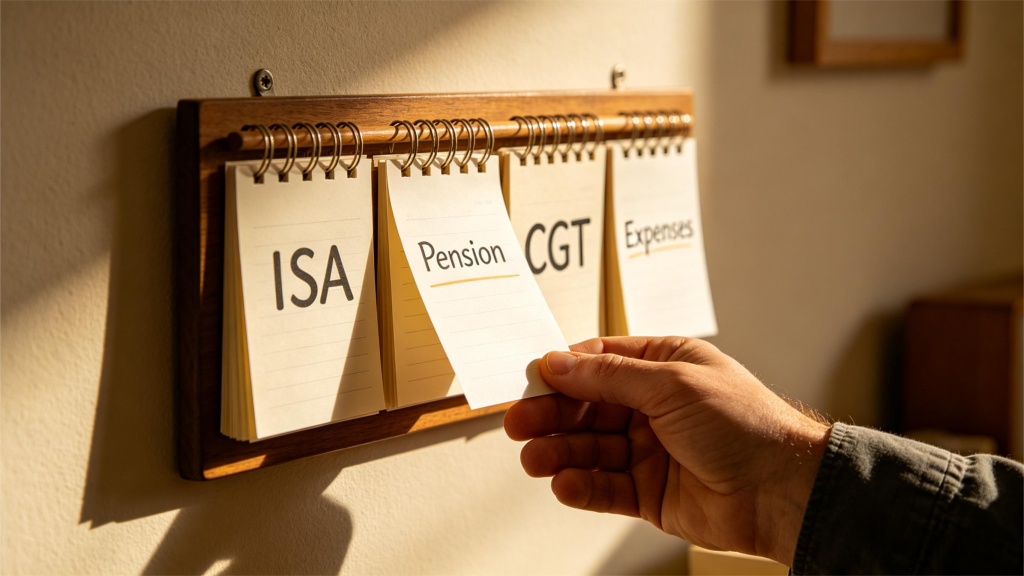
Introduction
With the tax year ending on April 5th, the countdown begins for Self Assessment taxpayers. While the filing deadline for the 2025/26 tax year is January 31, 2027, the end of the tax year is the moment when you can no longer change your income or use certain allowances. This quick checklist is designed for people who file a Self Assessment return – the self‑employed, higher earners, landlords, or anyone with untaxed income. It focuses on actions to take before April 5th to minimise your tax bill and avoid penalties.
Based on rules as of March 2026. Always verify current rates with official sources.
Why a Pre-April 5th Checklist Matters
After April 5th, the tax year is closed. You cannot:
- Use your ISA allowance for that year.
- Make pension contributions count for that year (except through carry forward, but that is different).
- Change the timing of income or expenses for the closed year.
However, for Self Assessment, you have until January 31 of the following year to file your return. This creates a trap: many people wait until December or January to prepare their return, only to discover that they missed opportunities to reduce their tax bill because they did not act before the April 5th deadline.
Example: In January 2027, you realise you have a large capital gain from a share sale in August 2025. You could have sold more shares to use the annual exempt amount, but it is too late – the tax year ended in April 2026. You cannot go back.
This checklist ensures you act while you still can.
Check 1: Have You Used Your ISA Allowance?
The ISA allowance (for illustration, £20,000) is a use‑it‑or‑lose‑it benefit. If you are a basic rate taxpayer with savings interest exceeding £1,000, or a higher rate taxpayer with interest exceeding £500, an ISA shelters that interest from tax.
Action: Log into your ISA provider(s). Calculate total contributions for 2025/26. If you have unused allowance, transfer money before April 5th. Prioritise a Lifetime ISA (if eligible) for the 25% bonus.
Check 2: Maximise Pension Contributions
Pension contributions reduce your “adjusted net income” – the figure used to calculate your tax liability, your Personal Allowance (tapered above £100,000), and the High Income Child Benefit Charge.
Action: Estimate your income for 2025/26. If you are close to a threshold (£50,000 for Child Benefit charge, £100,000 for Personal Allowance taper, £125,140 for 60% effective tax rate), consider making a pension contribution to bring your income below the threshold.
Example: You earn £103,000. Your Personal Allowance of £12,570 is reduced by £1 for every £2 over £100,000 – so you lose £1,500 of allowance, paying 40% tax on that £1,500 (£600 extra tax). A £3,000 gross pension contribution (£2,400 net for a higher rate taxpayer) reduces your adjusted net income to £100,000, restoring your full Personal Allowance. The net cost of the contribution is £2,400, but you save £600 in tax – effective cost £1,800 for £3,000 in your pension.
Deadline: Contributions must reach your pension provider by April 5th. If paying by cheque or bank transfer, allow 3–5 working days.
Check 3: Review Capital Gains – Use the Annual Exempt Amount
The CGT annual exempt amount (for illustration, £6,000 for 2025/26) is also use‑it‑or‑lose‑it. If you have assets held outside an ISA or pension with unrealised gains, consider selling enough to use the exemption.
Action: Calculate the gain on each asset. Remember that you can deduct costs of acquisition and improvement, plus the annual exemption. If you have losses from previous years, you can use those to offset gains.
Bed and breakfasting reminder: You cannot sell an asset and buy it back within 30 days. However, you can sell shares in one company and buy shares in a different company, or sell an ETF and buy a different ETF tracking the same index.
If you are married or in a civil partnership: You can transfer assets between spouses without triggering CGT. This allows you to use both annual exempt amounts (£6,000 each = £12,000 total gain tax‑free).
Check 4: Review Dividend Income
The dividend allowance (for illustration, £500 for 2025/26) has been drastically reduced in recent years. Dividends above this amount are taxed at 8.75% for basic rate, 33.75% for higher rate, and 39.35% for additional rate.
Action: If you receive dividends from shares or funds held outside an ISA, consider selling some of those holdings and reinvesting inside an ISA or pension before the end of the tax year. This is not always practical (you may trigger CGT), but it is worth analysing.
For company directors: If you take dividends from your own limited company, you have some control over timing. Delaying a dividend payment until after April 5th pushes the income into the next tax year – useful if you expect to be in a lower tax band next year.
Check 5: Accelerate or Defer Income and Expenses
As a self‑employed person or landlord, you have some flexibility over when you invoice clients or when you pay for deductible expenses.
Accelerate expenses – If you are going to have a high income year, consider paying for deductible business expenses before April 5th (e.g., buying equipment, prepaying software subscriptions, making pension contributions). This reduces your taxable profit for the current year.
Defer income – If you expect to be in a lower tax band next year (e.g., you are taking a career break), consider delaying invoicing until after April 5th. However, HMRC has rules against “artificial” deferral – the income must genuinely be earned after the deadline.
For landlords: Repairs and maintenance are deductible when the work is done, not when you pay. If you have a repair scheduled for early April, ask the tradesperson to invoice and complete the work before April 5th.
Check 6: Claim the Marriage Allowance
If you are married or in a civil partnership and one partner earns below the Personal Allowance (approx £12,570) while the other earns between £12,571 and £50,270, you can transfer £1,260 of allowance. This saves the higher earner up to £252 per year.
Action: Apply via GOV.UK. You can backdate claims for up to four tax years. A couple who has never claimed could receive over £1,000 in refunds.
Check 7: Gift Aid – Use Higher Rate Relief
If you are a higher or additional rate taxpayer, Gift Aid donations made before April 5th can reduce your tax bill.
Action: Gather all Gift Aid confirmation letters. On your Self Assessment return, you will enter the total gross donations (your donation plus the 25% basic relief). HMRC will then give you relief at your marginal rate.
If you do not normally file a Self Assessment return: You can still claim higher rate relief by writing to HMRC or via your Personal Tax Account. Keep donation receipts.
Check 8: Claim Employment Expenses (Even If Self-Employed)
If you are employed and also self‑employed (a common situation), you can claim tax relief for employment expenses not reimbursed by your employer. This includes professional subscriptions, uniform cleaning, and working from home.
Action: Use HMRC’s online portal. Claims for up to four tax years can be made.
Check 9: Have You Registered for Self Assessment?
If you have not yet registered for Self Assessment but you know you need to file a return for 2025/26 (e.g., you became self‑employed during the year), register immediately. The registration deadline is October 5th following the end of the tax year (i.e., October 5, 2026 for the 2025/26 tax year). But registering early avoids last‑minute stress and ensures you receive your Unique Taxpayer Reference (UTR) in time.
Action: Register on GOV.UK. You will need your National Insurance number and details about your income.
Check 10: Prepare Your Records for Filing
Even if you will not file your return until January 2027, prepare your records now while the information is fresh.
Gather:
- All bank statements for business and personal accounts (for interest and expenses).
- Invoices issued and received.
- Receipts for expenses.
- P60 or P45 if you had employment income.
- Dividend vouchers.
- Capital gains records (contract notes for purchases and sales).
Consider using accounting software – many self‑employed people use free or low‑cost tools that integrate with HMRC’s Making Tax Digital (MTD) system. MTD for Income Tax is being phased in; if you have business income over £50,000, you will need to use MTD-compatible software from April 2026 (for illustration – check current deadlines).
Key Takeaways
- Use ISA allowance by April 5th – it cannot be carried forward.
- Maximise pension contributions – especially if you are near a tax threshold (£50k, £100k, £125k).
- Use CGT annual exempt amount – sell assets to realise gains tax‑free.
- Accelerate expenses, defer income – if it makes tax sense for your situation.
- Claim Marriage Allowance and Gift Aid relief – often missed.
- Register for Self Assessment early – do not wait until October.
This article is for general information and educational purposes only. It does not constitute financial advice. Tax rules, allowances, and product terms may change. Always check with HMRC or an FCA-authorised adviser for your personal circumstances.