Introduction
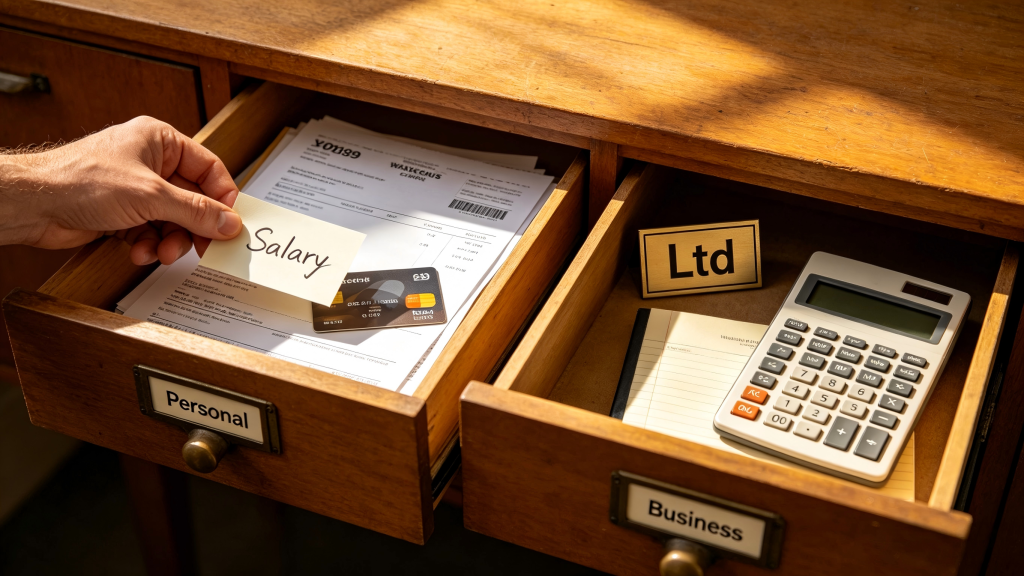
Starting a business is exciting. But in the rush to find customers, build a product, and generate revenue, many new business owners overlook a critical foundation: separating personal and company finances. Mixing the two creates tax nightmares, legal risks (piercing the corporate veil), and personal liability for business debts. This guide explains why separation matters, how to structure your business (sole trader vs limited company), and the practical steps to keep your personal and business finances distinct – from bank accounts to credit cards to accounting systems.
Based on rules as of June 2026. Always verify current rates with official sources.
Why Separation Matters
Legal liability: If you operate as a sole trader, you are personally liable for all business debts. A creditor can seize your personal savings, car, and even your home. If you operate as a limited company, the company is a separate legal entity. Your personal liability is limited to what you have invested (typically the value of your shares). However, if you mix personal and company finances – e.g., paying personal bills from the company account – a court may “pierce the corporate veil” and hold you personally liable.
Tax accuracy: HMRC expects clean records. If you use your personal bank account for business transactions, you will struggle to identify deductible business expenses. You may miss deductions (overpaying tax) or claim personal expenses as business deductions (risking penalties). A separate business bank account makes record‑keeping simple.
Professionalism: Paying business expenses from a business account (and receiving payments into that account) looks more professional to customers, suppliers, and HMRC. It also makes it easier to track cash flow.
Simplified accounting: At tax time, you can download business account statements and know that every transaction is business‑related. No need to sift through months of personal transactions to find the occasional business expense.
Sole Trader vs Limited Company: Different Separation Needs
Sole trader: You and the business are legally the same entity. You do not need a separate business bank account – but it is highly recommended. You can use your personal account, but then you must carefully track which transactions are business and which are personal. HMRC expects you to keep separate records, even if the same account is used.
Limited company: The company is a separate legal entity. You must keep company money separate from personal money. The company must have its own bank account. You cannot pay personal expenses from the company account (except as lawful director’s loans, salary, or dividends). Mixing is a breach of company law and can lead to disqualification.
Recommendation for both: Open a separate business bank account. Many banks offer free business accounts for startups (often free for 12–24 months). Even if there is a small fee, the time saved on accounting is worth it.
Step 1: Choose Your Business Structure
Before separating finances, decide your legal structure.
Sole trader:
- Simple to set up (register for Self Assessment, no Companies House filing).
- You pay Income Tax and NICs on profits.
- Unlimited liability – personal assets at risk.
- Best for: freelancers, consultants, small retail, low‑risk businesses.
Limited company:
- Separate legal entity, limited liability.
- You pay Corporation Tax on profits, then you pay Income Tax on dividends or salary.
- More administration (annual accounts, confirmation statement, Companies House filing).
- Best for: businesses with higher profits (over £30,000–£50,000), businesses with liability risks (e.g., construction, advice), businesses seeking investment.
If you are unsure: Start as a sole trader (you can incorporate later). The cost and complexity of a limited company are not worthwhile for very small businesses.
Step 2: Open a Dedicated Business Bank Account
For sole traders: You can open a business account in your own name (e.g., “John Smith trading as Smith Consulting”). Many high street banks and online challenger banks offer business accounts with low or no fees for the first year.
For limited companies: The account must be in the company’s legal name (e.g., “Smith Consulting Ltd”). You will need the company’s certificate of incorporation and your director ID.
What to look for in a business account:
- Monthly fees (free vs £5–£10 per month).
- Transaction fees (free for a certain number of transactions, then a per‑transaction fee).
- Integration with accounting software (e.g., Xero, QuickBooks, FreeAgent).
- Overdraft facilities (if needed).
- Online banking quality.
Do not use your personal account for business. Even if you are a sole trader, using a separate account saves enormous accounting effort.
Step 3: Separate Payment Methods
Business debit card: Use for all business expenses – software subscriptions, office supplies, travel, advertising. Never use it for personal spending (groceries, cinema, clothes).
Business credit card: Useful for tracking expenses and building business credit. Many business credit cards offer rewards (cashback, air miles). Pay the balance in full each month to avoid interest.
Personal credit card: If you must pay a business expense on a personal card, transfer the amount from your business account to your personal account immediately and keep a record. Better to avoid this – it creates extra tracking.
Petty cash: If you need cash for small business expenses (e.g., buying lunch for a client), withdraw from the business account and keep receipts. Record the expense in your accounting system.
Step 4: Pay Yourself Properly
Sole trader: You do not “pay yourself” in the traditional sense. You simply transfer money from your business account to your personal account as drawings. Keep a record of each transfer. At the end of the year, your taxable profit is your business income minus allowable expenses – not the amount you transferred.
Limited company: You can pay yourself through:
- Salary – processed through payroll (PAYE). You pay Income Tax and NICs on salary. The company claims the salary as an expense, reducing Corporation Tax.
- Dividends – paid from post‑tax profits. Dividends are not subject to NICs and have lower Income Tax rates (8.75% basic, 33.75% higher). You can only pay dividends if the company has sufficient retained profits.
- Director’s loan – you borrow money from the company. If not repaid within 9 months of the year end, the company pays a tax charge (Section 455). Avoid using director’s loans for personal spending.
Typical tax‑efficient strategy for small limited companies: Pay yourself a salary up to the National Insurance Secondary Threshold (approx £9,100 per year – check current), which avoids employer NICs, and take the rest as dividends. Consult an accountant.
Step 5: Track Everything with Accounting Software
Manual spreadsheets work for very small businesses, but accounting software saves time and reduces errors.
Recommended features:
- Bank feed – automatically imports transactions from your business account.
- Categorisation – assign each transaction to an expense category (office supplies, travel, marketing, etc.).
- Invoicing – create and send invoices, track paid vs unpaid.
- VAT – if you are VAT registered, the software should handle VAT returns.
- Tax estimation – estimates your Income Tax or Corporation Tax liability.
For sole traders: FreeAgent (often free with a business bank account) or QuickBooks Self‑Employed. Cost £10–£20 per month.
For limited companies: Xero, QuickBooks, or FreeAgent. Cost £15–£30 per month.
Keep personal accounting separate: Do not enter personal transactions into your business accounting software. Use a separate personal finance tool (or a simple spreadsheet).
Step 6: Handle Transfers Between Personal and Business
Sometimes you need to move money between accounts – e.g., you invest personal savings into the business, or you take drawings/dividends out.
For sole traders:
- Personal to business: Transfer money from personal account to business account. Record as “director’s capital introduced” (not taxable). It increases your basis but does not affect profit.
- Business to personal (drawings): Transfer money. Record as “drawings” – not a deductible expense, but it reduces the cash available. At year end, your taxable profit is calculated without regard to drawings.
For limited companies:
- Personal to business (loan to company): Transfer, document as a director’s loan. The company owes you the money. You can repay yourself later tax‑free.
- Business to personal (salary or dividend): Process through payroll (salary) or declare a dividend (board minutes, dividend voucher). Transfer the net amount. Keep proper documentation.
Never simply transfer money without a record. HMRC may reclassify it as income or a taxable benefit.
Step 7: Separate Business and Personal Savings
If your business accumulates cash beyond what you need for working capital, keep it in a business savings account (not your personal ISA or savings account). Interest earned on business savings is taxable as business income (sole trader) or subject to Corporation Tax (limited company).
For sole traders: You can transfer excess business cash to your personal savings (as drawings), then invest it personally (e.g., in an ISA). This removes the cash from the business and avoids tax on interest at your personal rate (though you already paid tax on the profit when earned). Consult an accountant.
For limited companies: Excess cash can be left in the company (paying Corporation Tax on profits) and invested in a business savings account or business investment account. Alternatively, you can pay a dividend to extract the cash and invest personally. The decision depends on your personal tax rate vs Corporation Tax rate.
Step 8: Register for Taxes Separately
Sole trader: You do not need a separate tax registration. Your Self Assessment covers both personal and business income. However, HMRC expects you to complete the self‑employment pages (SA103).
Limited company: The company must register for Corporation Tax (within 3 months of starting to trade). You as a director may also need to register for Self Assessment (if you have income not covered by PAYE – e.g., dividends). The company must also register for PAYE if you pay yourself a salary (even if you are the only employee).
VAT: If your business turnover exceeds the VAT threshold (for illustration, £90,000 – check current), you must register for VAT. Once registered, you must submit VAT returns (usually quarterly) and charge VAT on your invoices. You can reclaim VAT on business purchases.
Common Mistakes and How to Avoid Them
Mistake 1: Using personal account for business “just for a few months.” Those months turn into years. Open a business account on day one.
Mistake 2: Paying personal expenses from business account and calling it “director’s loan.” HMRC scrutinises these. If you cannot repay within 9 months, the company pays a tax charge. Avoid unless you have a clear repayment plan.
Mistake 3: Not keeping receipts for cash expenses. Even small expenses (parking, coffee with a client) add up. Use a mobile app to photograph receipts immediately.
Mistake 4: Mixing VAT and non‑VAT transactions. If you are VAT registered, ensure your accounting software separates them correctly. Claiming VAT on personal purchases is fraud.
Mistake 5: Not paying yourself a salary from a limited company (taking everything as dividends). Dividends do not count as earnings for certain purposes (e.g., mortgage applications, State Pension). Pay yourself a modest salary to build National Insurance contributions.
Key Takeaways
- Separate business and personal finances from day one – open a dedicated business bank account.
- Sole trader vs limited company – limited company offers liability protection but more administration.
- Use accounting software – automates tracking and reduces errors.
- Document all transfers between personal and business accounts (drawings, director’s loans, dividends).
- Keep business savings separate – do not mix with personal ISAs or savings.
- Register for taxes appropriately – Self Assessment, Corporation Tax, VAT if required.
- Avoid common mistakes – paying personal expenses from business account, failing to keep receipts.
This article is for general information and educational purposes only. It does not constitute financial advice. Tax rules, allowances, and product terms may change. Always check with HMRC or an FCA-authorised adviser for your personal circumstances.