Introduction
Summer holidays are something to look forward to – but they can also derail your finances if you do not plan ahead. Between flights, accommodation, spending money, and the inevitable unexpected costs (a missed connection, lost luggage, a medical emergency), a holiday can cost much more than you anticipated. This guide covers how to budget for a summer holiday, save effectively, and choose the right travel insurance to protect yourself and your belongings. The goal is to enjoy your time away without returning to a credit card hangover.
Based on rules as of July 2026. Always verify current rates with official sources.
Step 1: Set a Realistic Holiday Budget
Before you book anything, decide how much you can afford to spend on the entire trip – including all transport, accommodation, food, activities, souvenirs, and a contingency fund (10–15% of the total for unexpected costs).
How to set the budget:
- Look at your disposable income (after essential bills, savings, and debt payments). How much can you save per month between now and the holiday?
- Multiply by the number of months until departure. That is your maximum budget.
- If the budget is too low for your dream destination, either save longer, choose a cheaper destination, or reduce other discretionary spending.
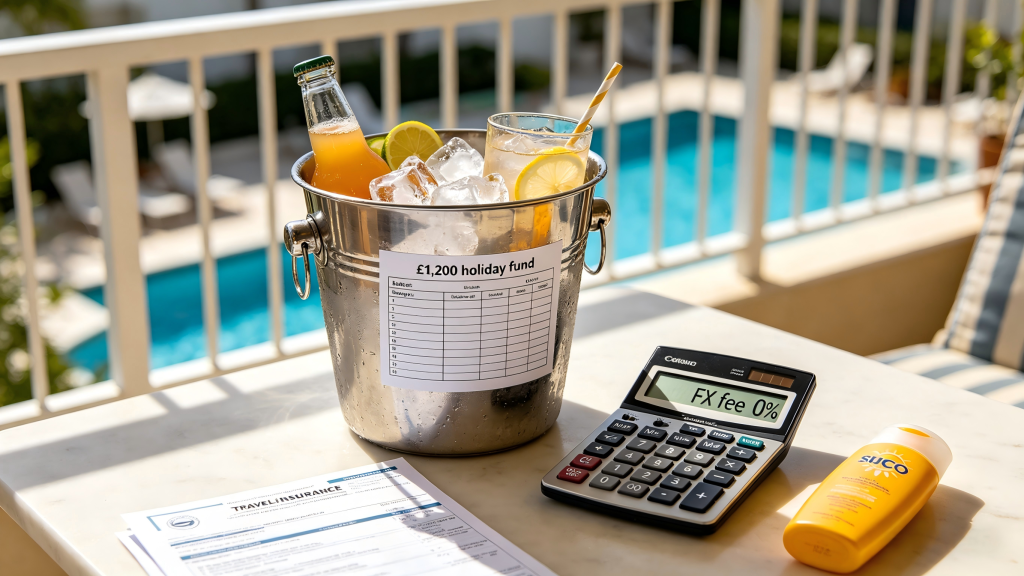
Example: You want to go on holiday in 6 months. You can save £200 per month. Total budget = £1,200. That includes everything – flights, accommodation, food, activities. If flights alone cost £400, you have £800 left for 7 nights – about £114 per day. That is feasible for budget travel in Europe, but not for a luxury resort.
Use a holiday sinking fund: Open a separate savings account (or use a pot in your banking app) and transfer your monthly holiday savings there. Do not keep the money in your current account – it will get spent.
Step 2: Choose Your Destination and Timing Wisely
Peak season (July–August): Prices for flights and accommodation are highest. School holidays restrict families, but if you do not have children, consider travelling in June or September. The weather is often still good, and prices can be 30–50% lower.
Avoid school holidays if possible: Even if you have children, some schools allow authorised absence in term time (though fines apply for unauthorised absence – typically £60 per parent per child). For many families, the savings on holiday costs outweigh the fine. Check your local council’s policy.
All‑inclusive vs self‑catering: All‑inclusive can be good value if you eat and drink a lot. Self‑catering gives you flexibility and can be cheaper if you cook some meals. Calculate the daily cost of food and drink at your destination to decide.
Step 3: Pay for the Holiday in Advance (Avoid Debt)
The worst way to pay for a holiday is to put it on a credit card and carry the balance. The interest (20%+ APR) will turn a £1,000 holiday into a £1,200 holiday if you pay it off over a year – and that is before you add the spending money.
Best practice:
- Save the full amount before you travel.
- Pay for flights and accommodation using a credit card (for Section 75 protection – see below) but clear the balance immediately with your savings.
- For spending money, use a debit card or a prepaid travel card.
If you must borrow: A 0% purchase credit card (if you can repay before the 0% period ends) or dipping into savings (but not your emergency fund) are better than paying high interest. Better still: choose a cheaper holiday.
Step 4: Travel Insurance – Why You Need It
Travel insurance is not a luxury – it is essential. Without it, a medical emergency abroad could cost tens of thousands of pounds. The UK has reciprocal health agreements with some countries (European Economic Area countries under the GHIC card – see Step 5), but these do not cover private treatment, medical repatriation, or lost luggage.
What travel insurance typically covers:
- Emergency medical expenses (including hospital treatment, ambulance, repatriation to the UK).
- Cancellation or curtailment (if you cannot travel or must return early due to illness, a family emergency, or other covered reasons).
- Lost, stolen, or delayed baggage.
- Personal liability (if you accidentally injure someone or damage property).
- Legal expenses.
- Travel delay (payout after a certain number of hours).
What is often not covered:
- Pre‑existing medical conditions (unless declared and accepted).
- Extreme sports (skiing, scuba diving, bungee jumping – you may need a specialist policy).
- Travel to countries with FCDO “do not travel” advice.
- Claims arising from alcohol or drug use (if you are intoxicated).
How to choose a policy:
- Annual multi‑trip – cheaper than single‑trip if you take 2+ holidays per year.
- Check the medical cover limit – at least £2 million (some policies offer £5–10 million).
- Check the cancellation limit – enough to cover your non‑refundable costs (flights, hotels).
- Declare all pre‑existing conditions – failure to do so invalidates your cover.
- Read the excess – the amount you pay towards a claim. A £100 excess is typical. Lower excess = higher premium.
Beware of “free” travel insurance – e.g., from a packaged bank account or a credit card. These often have low cover limits, high excesses, and many exclusions. Check the policy wording. They may be better than nothing, but a dedicated travel insurance policy is usually superior.
Step 5: The GHIC (Global Health Insurance Card)
The GHIC (replacing the old EHIC) provides access to state‑provided healthcare in EU countries (and some other countries) at the same cost as a local resident – often free or reduced cost. It is not a replacement for travel insurance because:
- It does not cover private treatment (you may be treated in a private hospital and billed).
- It does not cover repatriation to the UK (an air ambulance can cost £10,000–£30,000).
- It does not cover lost luggage, cancellation, or other non‑medical issues.
Get a GHIC: Apply online via the NHS website. It is free. Carry it with your passport.
For travel outside the EU: GHIC is not valid. You must rely on travel insurance (and possibly a reciprocal agreement, but few exist). Some countries (Australia, New Zealand) have their own arrangements – check.
Step 6: Payment Methods Abroad
Using your UK debit or credit card abroad can incur fees:
- Foreign transaction fee – typically 3% of the transaction amount. A £1,000 holiday spend costs £30 in fees.
- Cash withdrawal fee – typically 3% + a fixed fee (£2–£5). Avoid withdrawing cash from ATMs abroad unless necessary.
Better options:
- Specialist travel credit cards – some offer 0% foreign transaction fees. Use for spending, pay in full each month.
- Prepaid travel cards – load pounds, convert to local currency at a fixed rate. Fees vary; compare.
- Debit cards from challenger banks – many (e.g., Monzo, Starling, Revolut) offer fee‑free spending abroad (within limits). Check their fair usage policies.
Always pay in the local currency – if a merchant offers to charge you in pounds (Dynamic Currency Conversion), decline. Their exchange rate is terrible.
Step 7: Protect Your Belongings
Before you travel:
- Check your home contents insurance – does it cover items taken outside the home (personal possessions cover)? There is often a limit (e.g., £1,000 total, £250 per item). If you are taking an expensive laptop, camera, or jewellery, you may need additional cover.
- Take photos of valuables (serial numbers) and keep receipts.
- Use a hidden money belt or RFID‑blocking wallet to prevent card skimming.
During the holiday:
- Do not leave valuables unattended on the beach or in a car.
- Use the hotel safe for passports, extra cash, and electronics.
- Keep a copy of your passport and travel insurance policy separately (e.g., in your email or cloud storage).
Step 8: What to Do If Something Goes Wrong
Medical emergency: Call the local emergency number (112 in Europe, 911 in North America). Contact your travel insurance provider as soon as possible – they have 24‑hour assistance lines. Keep all receipts.
Lost or stolen passport: Report to local police (get a crime reference number). Contact the nearest British embassy or consulate. They can issue an emergency travel document.
Flight cancellation or delay: Check your rights under UK law (Retained EU Regulation 261/2004). For delays over 3 hours, you may be entitled to compensation (£220–£520 per person) plus meals and accommodation. Keep all boarding passes and receipts.
Missed connection due to delay: If you booked flights separately (not as a single ticket), you may not be covered. Always book connecting flights on one ticket if possible. Your travel insurance may cover missed connections – check the policy.
Baggage delayed or lost: Report immediately at the airport (get a Property Irregularity Report – PIR). Your travel insurance covers essential purchases (toiletries, clothes) while you wait. Keep receipts.
Step 9: After the Holiday – Manage Any Debt
If you overspent (it happens), have a plan:
- Pay off the credit card balance as soon as possible – do not let interest accrue.
- Reduce discretionary spending for the next 2–3 months – no takeaways, no new clothes, fewer subscriptions.
- If you used a 0% credit card, set up a payment plan to clear it before the 0% period ends.
- Start saving for next year’s holiday now – even £20 per month will give you £240 by next summer.
Key Takeaways
- Set a realistic budget – save in a separate sinking fund, do not borrow.
- Travel insurance is essential – medical cover of at least £2 million, declare pre‑existing conditions.
- GHIC is not a substitute – get one, but still buy insurance.
- Avoid foreign transaction fees – use a fee‑free card or specialist travel card.
- Pay in local currency – decline dynamic currency conversion.
- Know what to do in an emergency – keep insurance and embassy numbers handy.
- If you overspend, recover quickly – cut back for a few months, start saving for next year.
This article is for general information and educational purposes only. It does not constitute financial advice. Tax rules, allowances, and product terms may change. Always check with HMRC or an FCA-authorised adviser for your personal circumstances.