Introduction
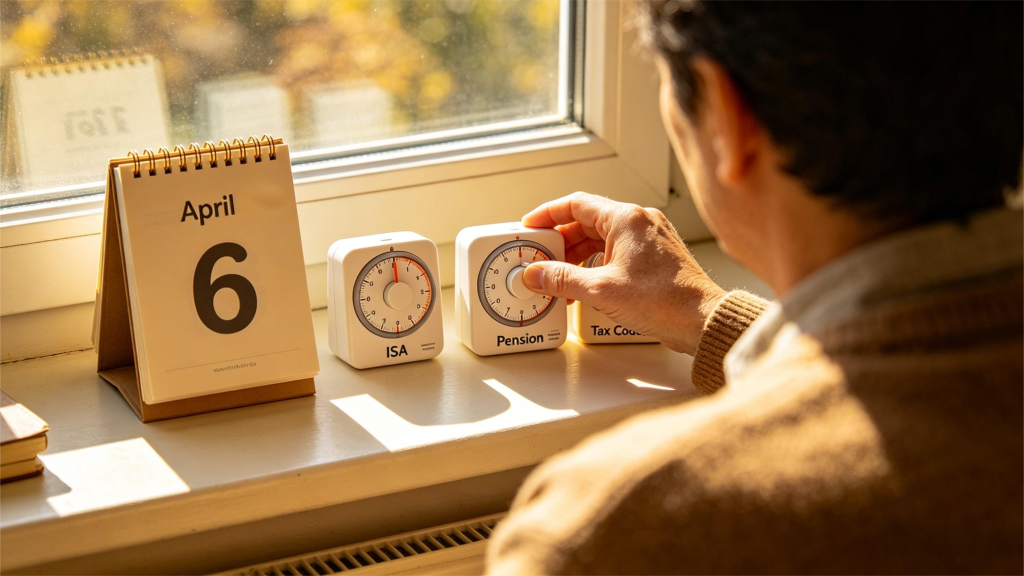
April 6th marks the beginning of a new tax year – and with it, a fresh set of allowances. The ISA allowance resets, the pension annual allowance restarts, and your Personal Savings Allowance, dividend allowance, and Capital Gains Tax exempt amount all become available again. For anyone who missed opportunities in the previous year, the new tax year offers a clean slate. This guide provides a framework for starting your new tax year financial plan: prioritising which allowances to use, setting up automated systems, and aligning your plan with your life goals.
Based on rules as of April 2026. Always verify current rates with official sources.
The Key Allowances for the New Tax Year (2026/27 Illustration)
The following figures are illustrative and subject to change. Always check the current rates on GOV.UK.
| Allowance | Approximate amount (2026/27) | Use it for |
|---|---|---|
| ISA overall allowance | £20,000 | Tax‑free savings and investments |
| Lifetime ISA allowance | £4,000 (within overall £20k) | First home or retirement (25% bonus) |
| Junior ISA allowance | £9,000 | Saving for a child |
| Pension annual allowance | £60,000 (subject to taper) | Tax‑relieved retirement saving |
| Personal Savings Allowance | £1,000 (basic rate) / £500 (higher rate) | Tax‑free interest on ordinary savings |
| Dividend allowance | £500 | Tax‑free dividends from outside ISAs |
| CGT annual exempt amount | £6,000 | Tax‑free capital gains |
| Rent a Room relief | £7,500 | Tax‑free rental income from a lodger |
| Marriage Allowance | £1,260 transferable | Reducing a spouse’s tax bill |
Note: These figures are examples. The actual values for 2026/27 will be confirmed in the Autumn 2025 Budget or Spring 2026 Statement. Adjust your plan accordingly.
Step 1: Review Your Priorities for the Coming Year
Before allocating allowances, revisit your financial goals. Have your priorities changed?
Common goals and the allowances that support them:
- Building an emergency fund – Cash ISA (tax‑free interest) or ordinary savings account (using Personal Savings Allowance).
- Saving for a house deposit – Lifetime ISA (for first‑time buyers) or Cash ISA.
- Investing for long‑term growth (5+ years) – Stocks and Shares ISA (tax‑free growth) and pension (tax relief on contributions).
- Saving for a child – Junior ISA (tax‑free) or pension for the child (unusual but possible).
- Generating retirement income – Pension (tax relief on the way in) and ISA (tax‑free on the way out).
- Reducing tax on existing investments – Transfer assets into an ISA over time (using the annual allowance).
Action: Write down your top three financial goals for the next 12 months. Next to each, note which allowance(s) you will use.
Step 2: Set Up Monthly Automation for ISAs and Pensions
The single best habit is to automate your savings and investments. On April 6th (or the first payday after), set up standing orders or Direct Debits to use your allowances evenly across the year.
Example for ISA (£20,000 annual allowance):
- Monthly standing order: £1,666.66 (20,000 ÷ 12).
- If you cannot afford the full allowance, set a lower amount (e.g., £500 per month = £6,000 per year). You can always make additional lump sum contributions later.
Example for Lifetime ISA (£4,000 allowance):
- Monthly: £333.33. Or make a lump sum early in the tax year to maximise the time the bonus is invested.
Example for pension: Decide on a percentage of your salary (e.g., 10%). If your employer offers salary sacrifice, request the change through HR. If you pay into a personal pension, set up a monthly Direct Debit.
Why automation works: It removes the need for willpower. You never have to decide “should I save this month?” – the decision is already made.
Step 3: Use the ISA Allowance Strategically Throughout the Year
Many people wait until February or March to fund their ISA, then scramble to transfer money. This is inefficient for two reasons:
- Loss of potential growth – Money that sits in a current account earns little or no interest. Money in a Cash ISA or Stocks and Shares ISA can grow (or fall) over the full year.
- Lump sum risk – Investing a large lump sum just before a market crash is painful. Spreading contributions across the year (pound cost averaging) reduces this risk.
Strategy for Cash ISA: Fund early in the tax year if you have the cash. Interest accrues daily.
Strategy for Stocks and Shares ISA: Fund monthly (pound cost averaging) unless you receive a large bonus early in the year. If you have a lump sum, consider investing half immediately and half over the next 6 months.
Strategy for Lifetime ISA: Fund as early as possible to receive the government bonus quickly. The bonus is paid monthly (typically 4–8 weeks after your contribution). If you contribute £4,000 in April, the £1,000 bonus may arrive in May or June – giving it 11 months to grow.
Step 4: Coordinate ISAs and Pensions
For most people, the optimal order of saving is:
- Emergency fund (in easy access cash – not using ISA allowance if you have unused Personal Savings Allowance; if you exceed the PSA, use a Cash ISA).
- Workplace pension up to employer match – free money.
- Lifetime ISA (if first‑time buyer) – 25% bonus.
- Stocks and Shares ISA – tax‑free growth.
- Additional pension contributions – especially for higher rate taxpayers.
Why pensions come after ISAs for some? ISAs are more flexible – you can access the money before retirement without penalty (unlike a pension). For money you might need before age 57 (rising to 58), an ISA is better. For money definitely for retirement, a pension offers higher tax relief for higher rate payers.
Example: You are a basic rate taxpayer with an emergency fund already built. You have £1,000 per month to save. Employer matches 5% of salary in the workplace pension – you contribute 5% to get the match. Then you contribute £4,000 to a LISA (if buying a first home). Then you contribute the remainder to a Stocks and Shares ISA.
Step 5: Don’t Forget the Small Allowances
The big allowances (ISA, pension) get all the attention, but smaller allowances add up.
Personal Savings Allowance (£1,000/£500): If you are a basic rate taxpayer, you can earn £1,000 in savings interest tax‑free. That is equivalent to £50,000 in a savings account paying 2%. Most people do not exceed this. Only use a Cash ISA if you are already above the PSA.
Dividend allowance (£500): If you hold shares outside an ISA, you can receive up to £500 in dividends tax‑free. Above that, tax is due. If you expect more than £500 in dividends, consider moving those shares into an ISA over several years.
Rent a Room relief (£7,500): If you rent a furnished room in your main home to a lodger, the first £7,500 of rental income is tax‑free. No need to file a tax return if you earn below this amount.
Marriage Allowance (£1,260 transferable): If one spouse earns below the Personal Allowance and the other is a basic rate taxpayer, transfer £1,260 of allowance. Apply once – it continues each year until you cancel or your circumstances change.
Action: Check whether you qualify for any of these smaller allowances. They require little effort but can save hundreds of pounds.
Step 6: Plan for Capital Gains and Dividends Early
If you have significant investments outside an ISA or pension, do not wait until March to think about CGT and dividends. Instead:
- Estimate your gains and dividends for the year in April or May. Use last year’s statements as a guide.
- If you are likely to exceed the allowances, plan to sell assets gradually (using the annual exempt amount each year) rather than all at once.
- Consider “bed and ISA” – selling assets outside an ISA and buying them back inside an ISA (but beware the 30‑day rule and CGT on the sale).
Example: You have £100,000 in a general investment account with £20,000 of unrealised gains. The CGT annual exempt amount is £6,000. You could sell £30,000 worth of shares, realising approximately £6,000 of gain (assuming 20% gain). Pay no CGT. Transfer the £30,000 into your ISA over two years (using the £20,000 allowance each year). After 3–4 years, the entire portfolio is inside the ISA, tax‑protected.
Step 7: Review Your Tax Code Early in the New Tax Year
HMRC issues tax codes for the new tax year in February or March, based on their estimate of your income. Sometimes the code is wrong. In April, after your first payslip of the new tax year, check:
- Your tax code (on your payslip or HMRC app).
- Whether the expected Personal Allowance is correct.
- Whether any benefits in kind (company car, health insurance) are correctly recorded.
If the code is wrong, contact HMRC immediately. A corrected code can be applied to your next payslip.
Step 8: Schedule Regular Checkpoints
A plan is useless without review. Put these dates in your calendar:
- May 1st – Check that your ISA monthly standing orders are active. Confirm your pension contribution percentage.
- August 1st – Half‑year review. Are you on track to use your allowances? If not, increase contributions.
- January 1st – Final quarter review. Any unused allowances? Plan to use them by April 5th.
- April 6th (next year) – Start the cycle again.
Key Takeaways
- New tax year = new allowances – ISA, pension, CGT, dividend, and others reset on April 6th.
- Automate monthly contributions – standing orders for ISAs and pensions remove decision fatigue.
- Prioritise allowances based on your goals – LISA for first home, pension for retirement, ISA for flexibility.
- Use small allowances – Personal Savings Allowance, Marriage Allowance, Rent a Room relief.
- Plan CGT and dividends early – do not wait until March.
- Review your tax code in April – correct errors immediately.
This article is for general information and educational purposes only. It does not constitute financial advice. Tax rules, allowances, and product terms may change. Always check with HMRC or an FCA-authorised adviser for your personal circumstances.