Introduction
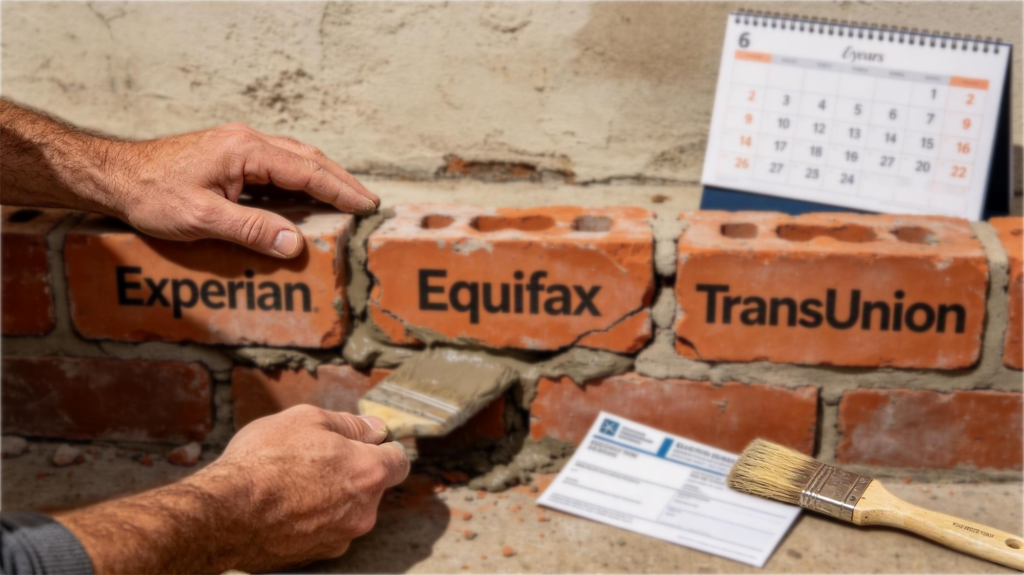
A poor credit record feels like a trap. Missed payments, defaults, or County Court Judgments (CCJs) can make it difficult to rent a home, get a mobile phone contract, or borrow at reasonable rates. But credit records are not permanent. Negative information typically disappears after six years, and you can take active steps to rebuild long before that. This guide provides a practical, step-by-step plan for credit repair – from assessing the damage to demonstrating responsible behaviour over time. It focuses on what you can do today, not on expensive “credit repair” services that promise magic solutions.
Based on rules as of January 2026. Always verify current rates with official sources.
Step 1: Obtain Your Credit Reports and Assess the Damage
You cannot fix what you have not measured. Obtain your statutory credit reports from all three credit reference agencies (Experian, Equifax, TransUnion). Use free services like ClearScore (Equifax), Credit Karma (TransUnion), and the statutory report from Experian.
Look for:
- Late payments – 30, 60, 90+ days late. Each late payment is recorded separately.
- Defaults – A default occurs after 3–6 months of missed payments. The account is closed, and the default is recorded. Defaults stay for 6 years from the default date.
- CCJs – County Court Judgments are public records. They stay for 6 years from the judgment date.
- IVA or bankruptcy – These stay for 6 years (or longer in some cases).
- Hard searches – Too many applications in a short period.
Categorise each negative item by severity:
- Minor: 1–2 late payments, high credit utilisation.
- Moderate: Multiple late payments, one default.
- Severe: CCJ, IVA, bankruptcy, multiple defaults.
Also check for errors – see article 14. Dispute any errors immediately. Removing an incorrect negative item can boost your score significantly.
Step 2: Address Outstanding Debts
Your credit report will show debts that are still owed, including defaults and CCJs. Ignoring them will not make them disappear. The six-year clock for removal starts from the default date or judgment date – but the debt remains legally owed until paid or statute-barred.
Statute-barred debt: In England and Wales, most debts become statute-barred (unenforceable in court) after 6 years with no payment or written acknowledgement. However, the credit record entry remains for 6 years from the default date. Do not make a partial payment on a statute-barred debt – that resets the clock.
Prioritise debts:
- CCJs – These are court orders. Failure to pay can lead to bailiffs, attachment of earnings, or charging orders on your home.
- Recent defaults (less than 3 years old) – These significantly impact your score. Lenders see them as evidence of recent financial distress.
- Older defaults (3–6 years) – These still affect your score but less severely. Consider whether paying them off is worth it (see below).
Should you pay off a default? It depends. A paid default is slightly better than an unpaid default – lenders see that you eventually settled the debt. But the default remains on your report for 6 years from the default date, regardless of payment. Paying a default does not remove it. If the default is close to the 6-year mark (e.g., 5 years old), you may choose to let it drop off naturally. If it is recent (1–2 years old), paying it shows responsibility.
Negotiate a “partial settlement” or “full settlement” marker: If you cannot pay the full amount, contact the creditor to negotiate. Offer a lump sum (e.g., 50% of the balance) in exchange for marking the debt as “satisfied” or “partially satisfied.” Get the agreement in writing before paying.
Step 3: Stop the Bleeding – Prevent New Negatives
You cannot rebuild while creating new problems. Stop any behaviour that leads to missed payments or defaults.
Immediate actions:
- Set up Direct Debits for all credit accounts – credit cards, loans, mobile phone bills, utilities. Even the minimum payment prevents a missed payment marker.
- If you cannot afford the minimum payment, contact your creditor to arrange a payment plan before you miss a payment. Creditors are often willing to help if you communicate early.
- Stop using credit cards if you are carrying a balance. Cut them up or freeze them in a block of ice (literally) to prevent impulse spending.
If you are struggling with multiple debts: Contact a free debt advice service – StepChange, National Debtline, or Citizens Advice. They can help you negotiate payment plans, debt management plans (DMPs), or consider more formal options (IVA, bankruptcy) if appropriate.
Step 4: Get on the Electoral Roll
Being registered on the electoral roll at your current address is one of the simplest and most effective credit repair steps. It confirms your identity and address to lenders.
How to register: Visit gov.uk/register-to-vote. You need your National Insurance number and date of birth. Registration takes 5 minutes.
If you cannot register (e.g., you are a foreign national not eligible to vote), you can add a “notice of correction” to your credit report explaining why you are not on the electoral roll. Some lenders will accept this.
If you have moved recently: Update your electoral registration immediately. Lenders check the electoral roll against the address you provide. A mismatch can lead to rejection.
Step 5: Build New, Positive Credit History
A credit report with only negative information and no positive information looks worse than one with a mix. You need to demonstrate responsible credit use going forward.
Credit builder credit cards: These are designed for people with poor or limited credit. They have low limits (typically £200–£1,000) and high interest rates (30–40% APR). The key is to use them responsibly: spend a small amount (e.g., £20 per month), set up a Direct Debit to pay the full balance each month, and never carry a balance. After 6–12 months of on-time payments, your score should improve, and you can apply for a standard card.
Guarantor credit cards: A friend or family member with good credit guarantees your card. If you miss payments, they become responsible. This can help, but it puts strain on relationships.
Loans for credit building: Some lenders offer small loans (£500–£1,000) with the express purpose of credit building. You borrow the money, and the lender places it in a locked savings account. You repay over 6–12 months, and the lender reports payments to the CRAs. These loans typically have high interest – only use them if you cannot get a credit builder credit card.
Important: Do not apply for multiple credit products at once. Each application leaves a hard search. Space applications by 3–6 months.
Step 6: Reduce Credit Utilisation
Credit utilisation is the percentage of your available credit that you are using. High utilisation (above 30%) signals financial distress. Low utilisation (below 10%) signals responsible management.
If you have a credit card with a £500 limit and a £450 balance: Utilisation = 90% – very bad. Even if you pay on time, this harms your score.
How to improve:
- Pay down the balance as quickly as possible.
- Request a credit limit increase (without spending more). A higher limit lowers your utilisation percentage. For example, if your limit increases from £500 to £1,000 and your balance stays at £450, utilisation drops from 90% to 45%.
- If you cannot get a limit increase, consider a second credit builder card to increase total available credit.
Do not close old credit cards – even if you do not use them. Closing a card reduces your available credit, which can increase your utilisation on remaining cards.
Step 7: Wait – Time Heals Most Wounds
Credit repair is not instant. Negative information remains for 6 years. But the impact of negative information fades over time. A default from 3 years ago affects your score less than a default from 6 months ago. A default from 5 years and 11 months ago barely affects your score at all – and will disappear entirely in 1 month.
What you can expect over time:
- 0–12 months after a negative event: Severe impact. Many lenders will reject you automatically.
- 12–24 months: Moderate impact. Some lenders may accept you with higher interest rates.
- 24–48 months: Mild impact. Most mainstream lenders will consider you, though rates may not be the best.
- 48–72 months: Minimal impact. The negative item is close to falling off.
Do not keep checking your score obsessively. Check monthly to monitor progress, but focus on behaviour (paying on time, reducing utilisation) rather than the number.
What Credit Repair Services Do (That You Can Do Yourself)
Companies that promise to “fix your credit” for a fee are typically selling what you can do for free. Legitimate credit repair involves:
- Obtaining your credit reports (free).
- Disputing errors (free – article 14).
- Adding notices of correction (free).
- Negotiating with creditors (free – you can do it yourself).
Avoid any company that:
- Charges an upfront fee.
- Promises to remove accurate negative information.
- Asks for your bank login details.
- Suggests creating a new credit identity (illegal).
When to Consider Professional Help (Free)
If your debt situation is overwhelming – multiple defaults, CCJs, or creditor pressure – you may need help. Free services include:
- StepChange – UK’s largest debt charity. They offer free advice and can set up Debt Management Plans (DMPs).
- National Debtline – Free telephone and webchat advice.
- Citizens Advice – Local offices provide face-to-face debt advice.
These services do not charge fees. They can help you understand options like Debt Relief Orders (DROs), Individual Voluntary Arrangements (IVAs), or bankruptcy. These have serious consequences (see article 43) but can be the right choice in extreme circumstances.
Key Takeaways
- Obtain all three credit reports – assess the damage and dispute errors.
- Address outstanding debts – pay CCJs first, negotiate defaults if possible.
- Stop new negatives – set up Direct Debits, stop using credit cards with balances.
- Get on the electoral roll – free and effective.
- Build positive history – credit builder card used responsibly.
- Time heals – most negatives disappear after 6 years.
This article is for general information and educational purposes only. It does not constitute financial advice. Tax rules, allowances, and product terms may change. Always check with HMRC or an FCA-authorised adviser for your personal circumstances.