Introduction
If you pay tax on savings interest, a Cash ISA is one of the most effective tools available. It acts as a protective wrapper: money inside a Cash ISA earns interest completely free of Income Tax, regardless of how much interest you generate. For basic-rate taxpayers who exceed the £1,000 Personal Savings Allowance, or for higher and additional-rate taxpayers with smaller allowances, a Cash ISA can save a significant amount of tax each year. This guide explains the core rules of Cash ISAs, how they differ from ordinary savings accounts, and how to choose between the many options available.
Based on rules as of September 2025. Always verify current rates with official sources.
What Is a Cash ISA?
ISA stands for Individual Savings Account. A Cash ISA is simply a savings account with a tax-free wrapper. You can deposit money, earn interest, and withdraw funds – exactly like an easy access or fixed-term savings account – but the interest is never taxed.
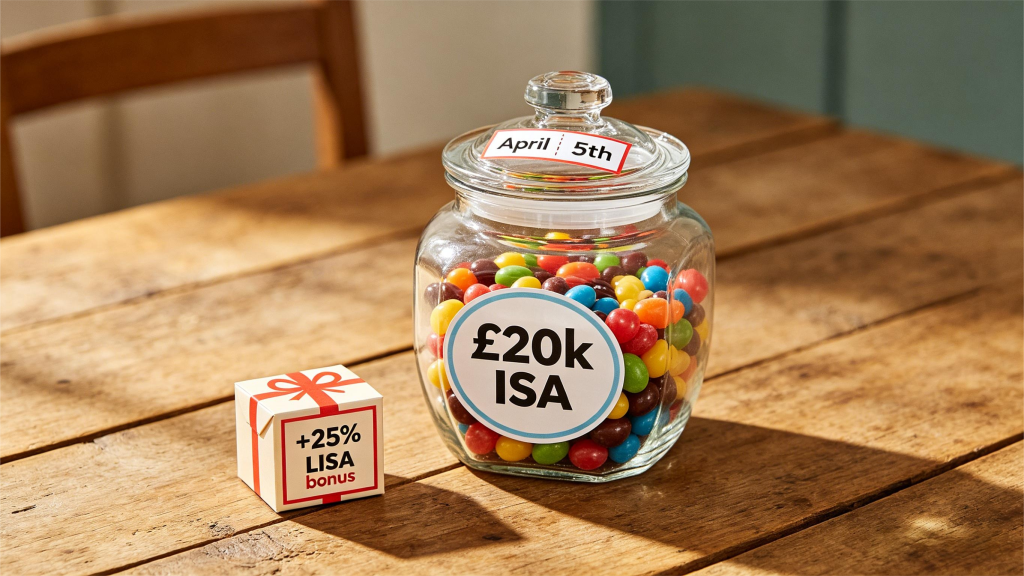
The government limits how much you can deposit across all types of ISAs (Cash, Stocks and Shares, Lifetime, Innovative Finance) in a single tax year. For the 2025/26 tax year (for illustration), the overall ISA allowance is £20,000. You can put all of that into a Cash ISA, or split it across different ISA types.
You must be a UK resident to open an ISA. Non-residents cannot contribute, though existing ISAs can remain open.
The Core Rules Every Cash ISA Saver Must Know
One Cash ISA per tax year: You can only pay into one Cash ISA in a given tax year (running April 6th to April 5th). However, you can open a new Cash ISA with a different provider each year. You are not locked into one provider forever.
You can transfer freely: Unlike the “one per year” subscription rule, you can transfer previous years’ Cash ISA balances between providers at any time, without affecting your current year allowance. Always use the ISA transfer process – never withdraw the money yourself and redeposit, as that would use up your current allowance.
Loss of tax-free status if you withdraw: If you withdraw money from a Cash ISA and do not replace it within the same tax year, you lose that portion of your allowance permanently. For example, if you deposit £10,000, withdraw £3,000, you cannot redeposit more than £10,000 that year (the £3,000 withdrawal does not reset your allowance).
Help to Buy ISA (closed to new accounts): The Help to Buy ISA closed to new accounts in November 2019. Existing accounts remain valid, and holders can continue saving until November 2029. Most new first-time buyers now use a Lifetime ISA instead (see article 13).
Types of Cash ISA
Just like ordinary savings accounts, Cash ISAs come in different access arrangements:
Easy Access Cash ISA: Withdraw money whenever you want. Interest rates are typically lower than fixed-term ISAs. Ideal for emergency funds or short-term savings where you might need access.
Fixed-Rate Cash ISA: Lock your money away for a set period (1 to 5 years) in exchange for a guaranteed interest rate. Early withdrawal usually triggers a penalty (e.g., losing 90 to 180 days of interest). Best for money you are certain you will not need during the term.
Notice Cash ISA: Require advance notice to withdraw (typically 30 to 120 days). Rates sit between easy access and fixed-term. Useful if you can plan withdrawals in advance.
Flexible Cash ISA: A newer feature offered by some providers. Flexible ISAs allow you to withdraw money and then replace it within the same tax year without losing your allowance. For example, if you withdraw £5,000 in December, you can repay £5,000 in March and still have used only £5,000 of your allowance. Standard ISAs do not offer this feature.
Cash ISA Versus Ordinary Savings Account
| Feature | Cash ISA | Ordinary savings account |
|---|---|---|
| Tax on interest | None | Taxable above Personal Savings Allowance |
| Annual deposit limit | £20,000 (overall ISA limit) | No limit |
| Access to money | Varies by account type | Varies by account type |
| FSCS protection | £85,000 per person, per institution | Same (£85,000) |
| Transfer between providers | Yes, via ISA transfer | Yes, via standard transfer |
When a Cash ISA makes sense:
- You have already used your Personal Savings Allowance (£1,000 for basic rate, £500 for higher rate).
- You are an additional-rate taxpayer (no Personal Savings Allowance).
- You have significant savings (£20,000+).
- You want to keep savings entirely separate from your taxable income.
When an ordinary savings account might be fine:
- You earn very little interest (below your Personal Savings Allowance).
- You are a non-taxpayer (e.g., retired with low income).
- You prefer the flexibility of unlimited deposits (though ISAs rarely reject deposits – you simply cannot exceed the annual limit).
How to Choose a Cash ISA Provider
Because this guide does not recommend specific providers, focus on these selection criteria:
1. Interest rate – Compare easy access rates separately from fixed rates. Remember that introductory bonus rates expire after 6 to 12 months. A provider offering 5% for 12 months then 1% thereafter might be worse than a provider offering 4.5% ongoing.
2. Access terms – Can you withdraw online instantly? Is there a branch if you prefer in-person access? Are there withdrawal limits (e.g., three withdrawals per year)?
3. Transfer flexibility – Does the provider accept transfers in from previous years’ ISAs? Do they charge a fee to transfer out? (Most do not, but check.)
4. Flexible ISA feature – If you might need to withdraw and replace money within the same tax year, prioritise flexible ISAs.
5. Provider stability and service – Check customer reviews (independently) for ease of use, app quality, and customer service wait times.
6. Fixed-term penalties – If considering a fixed-rate Cash ISA, read the early withdrawal penalty carefully. Losing 180 days of interest on a 2-year bond is severe.
Common Cash ISA Mistakes to Avoid
Mistake 1: Withdrawing money instead of transferring. If you want to move a Cash ISA from Bank A to Bank B, do not withdraw the cash to your current account. Request an ISA transfer form from Bank B. Otherwise, you lose the tax-free status on that money for the current year.
Mistake 2: Opening multiple Cash ISAs in one tax year. You can only subscribe (pay new money) to one Cash ISA per tax year. Opening a second Cash ISA and funding it breaches the rules. HMRC will contact you to rectify it.
Mistake 3: Using a Cash ISA when you are a non-taxpayer. If you pay no Income Tax, a Cash ISA offers no benefit over an ordinary savings account. You might find better interest rates outside ISAs.
Mistake 4: Keeping large amounts in a low-rate Cash ISA. ISAs are portable. If your current provider pays 1% and another pays 4%, transfer. Loyalty is rarely rewarded in savings.
The Lifetime ISA Alternative
If you are saving for a first home or retirement, a Lifetime ISA (LISA) might be more suitable than a standard Cash ISA. LISAs offer a 25% government bonus (up to £1,000 per year) but have stricter withdrawal rules. Article 13 covers LISAs in depth. For pure tax-free savings without bonus restrictions, a Cash ISA remains the simplest choice.
Key Takeaways
- Cash ISAs protect interest from tax – use them if you exceed your Personal Savings Allowance.
- Annual allowance (for illustration, £20,000) – applies across all ISAs.
- One Cash ISA per tax year – but you can transfer previous years freely.
- Always transfer, never withdraw – preserve your tax-free allowance.
- Match account type to timing – easy access for soon, fixed for later.
This article is for general information and educational purposes only. It does not constitute financial advice. Tax rules, allowances, and product terms may change. Always check with HMRC or an FCA-authorised adviser for your personal circumstances.