Introduction
When you start investing, you will hear two words constantly: funds and ETFs. They are the building blocks of most investment portfolios. But what exactly is a fund? How is an ETF different? And which should you use? This guide explains the basics of funds and ETFs in plain English – what they are, how they work, what they cost, and how to choose between them. By the end, you will understand terms like “OEIC,” “unit trust,” “tracker fund,” “accumulation units,” and “bid‑offer spread.”
Based on rules as of July 2026. Always verify current rates with official sources.
What Is an Investment Fund?
An investment fund (also called a collective investment scheme) pools money from many investors to buy a diversified portfolio of assets – shares, bonds, property, or other investments. Instead of buying 100 individual company shares yourself, you buy one fund that owns those 100 shares.
How it works:
- You buy “units” or “shares” in the fund.
- The fund manager uses the pooled money to buy assets according to the fund’s objective (e.g., “UK large companies,” “global government bonds”).
- The value of your units rises and falls with the value of the underlying assets.
- You can usually buy and sell units on any business day.
Why use funds? Instant diversification. One fund can give you exposure to thousands of companies. Funds also handle the administration (corporate actions, dividend collection, rebalancing) for you.
Open‑Ended Funds (OEICs and Unit Trusts)
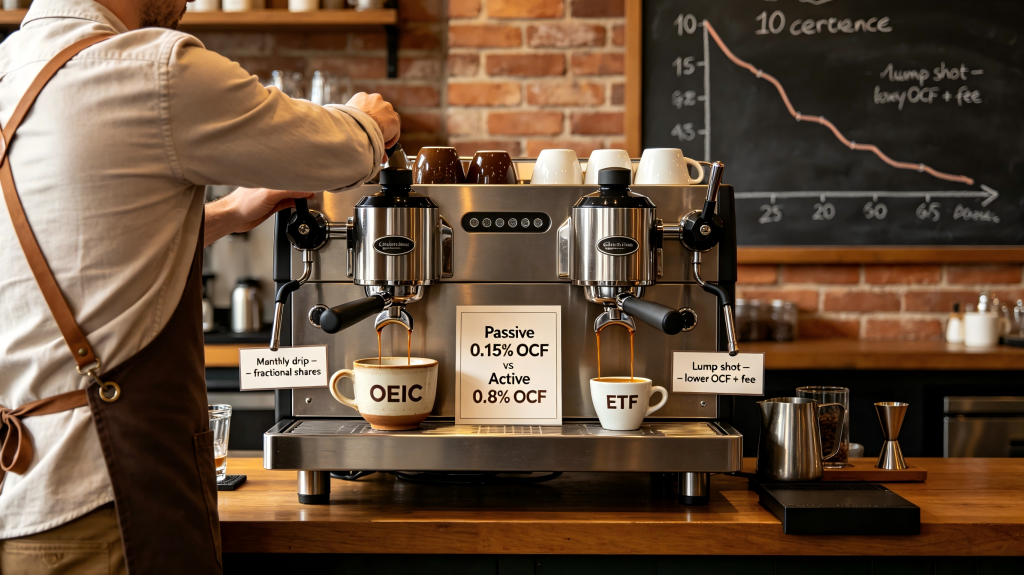
Open‑ended funds (OEICs – Open‑Ended Investment Companies – and unit trusts) are the most common type of fund in the UK. “Open‑ended” means the fund can create new units or cancel existing units based on investor demand. When you buy, the fund grows; when you sell, it shrinks.
Key features:
- Single daily price – You buy and sell at the Net Asset Value (NAV) calculated once per day (typically at 12pm). You do not know the exact price when you place your order (you get the next calculated price).
- No bid‑offer spread – You buy and sell at the same price (or a very small spread).
- Liquidity – You can usually sell on any business day, though settlement takes 2–4 days.
- Minimum investment – Often £500 lump sum or £50 per month.
Active vs passive open‑ended funds:
- Active fund – A manager researches companies and decides which to buy/sell, aiming to beat the market. Higher fees (0.7–1.5%).
- Passive fund (index tracker) – The fund simply replicates an index (e.g., FTSE 100). Lower fees (0.1–0.5%).
Accumulation vs income units:
- Accumulation (ACC) – Dividends are automatically reinvested to buy more units. The unit price rises. Best for ISAs and pensions.
- Income (INC) – Dividends are paid out as cash to your account. Best if you need the income (e.g., in retirement).
Open‑ended funds are best for: Regular monthly investing, long‑term buy‑and‑hold, investors who do not need intraday trading.
Exchange‑Traded Funds (ETFs)
ETFs are similar to open‑ended funds but trade on a stock exchange like a share. You buy and sell ETF shares throughout the trading day at market prices.
Key features:
- Intraday pricing – You can buy at 10:00am and sell at 2:00pm. The price changes constantly.
- Bid‑offer spread – There is a difference between the buying price (offer) and selling price (bid). For large, liquid ETFs (e.g., S&P 500 tracker), the spread is tiny (0.01–0.05%). For niche ETFs, it can be 0.5% or more.
- Trading fee – Most platforms charge a commission to buy or sell ETFs (£5–£15 per trade). Open‑ended funds are often free to trade.
- Ongoing charges – ETFs often have lower ongoing fees than open‑ended funds (0.05–0.30%).
- Minimum investment – You must buy whole shares (though some platforms now offer fractional shares for ETFs).
Physical vs synthetic ETFs:
- Physical ETFs – Actually hold the underlying assets (shares or bonds). Safer.
- Synthetic ETFs – Use derivatives to replicate index returns. Carry counterparty risk. Less common in Europe after new regulations.
ETFs are best for: Lump sum investing, investors who want intraday flexibility, niche exposures (commodities, specific sectors), and larger portfolios where trading fees are a small percentage.
Investment Trusts (Closed‑Ended Funds)
Investment trusts are a third type of pooled investment, but they are not funds in the same sense – they are closed‑ended companies listed on the stock exchange.
Key features:
- Fixed number of shares – The trust does not create or cancel shares based on demand. Shares trade on the exchange.
- Discounts and premiums – The share price can be below (discount) or above (premium) the NAV of the underlying assets. You can buy £100 of assets for £90 if the trust is at a 10% discount.
- Gearing (borrowing) – Investment trusts can borrow money to invest more. This amplifies returns (up and down).
- Dividend reserves – Trusts can retain up to 15% of income in good years to pay out in lean years, smoothing dividends.
Investment trusts are best for: Experienced investors comfortable with discounts, gearing, and exchange trading. They can offer value when bought at a discount, but they are more complex.
For beginners, open‑ended funds or ETFs are simpler.
Active vs Passive: The Most Important Decision
Within both open‑ended funds and ETFs, you have a choice between active and passive (index tracking). This choice matters more than the fund structure.
Active funds: A manager tries to beat the market. You pay higher fees for that expertise. Evidence shows that most active funds fail to beat their benchmark after fees, especially over long periods (10+ years). For example, over 15 years, more than 85% of actively managed UK equity funds underperformed the FTSE All‑Share.
Passive funds (index trackers): The fund simply follows an index. No manager research, no stock‑picking. Fees are much lower. You will match the market return (minus fees). Over long periods, matching the market typically puts you ahead of most active funds.
Recommendation for beginners: Start with passive funds. Once you have a solid portfolio (e.g., a global tracker), you can allocate a small portion (10–20%) to active funds if you enjoy researching them. But do not assume active will outperform.
Costs: OCF, TER, and Platform Fees
Ongoing Charges Figure (OCF) / Total Expense Ratio (TER): The annual cost of running the fund, expressed as a percentage of the fund’s assets. Includes management fees, admin, audit, etc. Does not include platform fees or trading costs.
Typical OCFs:
- Passive global equity ETF: 0.05–0.20%
- Passive UK equity fund: 0.05–0.15%
- Active UK equity fund: 0.7–1.2%
- Active global fund: 0.8–1.5%
- Bond fund: 0.1–0.5%
Platform fee: The fee your broker charges to hold the fund (see article 51). Add this to the OCF to get your total cost.
Trading costs: For open‑ended funds, often zero (platform may charge nothing). For ETFs, a dealing fee per trade.
Example total cost: You hold a passive global ETF (OCF 0.15%) on a platform charging 0.25% = 0.40% per year. On a £50,000 portfolio, that is £200 per year. An active fund (OCF 1.0%) on the same platform = 1.25% = £625 per year. The difference (£425 per year) compounds.
How to Choose Between an Open‑Ended Fund and an ETF
| Factor | Open‑ended fund | ETF |
|---|---|---|
| Best for | Monthly regular investing | Lump sum investing |
| Trading cost | Usually free | £5–£15 per trade |
| Ongoing fee | 0.1–1.5% | 0.05–0.7% |
| Pricing | Once daily, at NAV | Intraday, with spread |
| Minimum | Often £50 monthly | Price of one share |
| Fractional shares | Yes (you buy any amount) | No (unless platform offers) |
| Control over buy/sell time | No (you get next price) | Yes (you choose when to execute) |
Guidance:
- If you invest £100 per month, an open‑ended fund is better (free trading, fractional shares).
- If you invest £10,000 once, an ETF may be better (lower OCF, one trading fee is negligible).
- For a core lazy portfolio inside an ISA, many investors use open‑ended index funds for simplicity.
Reading a Fund Factsheet
When you look at a fund, you will see a Key Investor Information Document (KIID) or factsheet. Look for:
- Objective – What does the fund aim to do? (e.g., “track the FTSE All‑Share index”)
- Asset allocation – What does it invest in? (equities, bonds, etc.)
- Top holdings – The largest individual investments. A global tracker might have 5% in Apple, 4% in Microsoft, etc.
- Ongoing charge (OCF) – The annual fee.
- Performance – Past returns (remember: past performance does not predict future).
- Risk indicator – A number from 1 (low) to 7 (high). Equities are typically 5–6.
Red flags:
- OCF above 0.5% for a passive fund.
- A fund that has changed its objective or manager frequently.
- Very small fund size (under £50 million) – may close.
Common Mistakes with Funds and ETFs
Mistake 1: Paying too much. Using an active fund with OCF 1.5% when a passive alternative exists with OCF 0.1%. Over 30 years, that extra 1.4% consumes about 35% of your final returns.
Mistake 2: Buying an ETF for monthly investing. If your platform charges £10 per trade, buying an ETF every month costs £120 per year. On a £6,000 portfolio (500×12), that is 2% in trading fees alone – terrible.
Mistake 3: Choosing a niche ETF without understanding the spread. An ETF for “emerging market small cap value” might have a bid‑offer spread of 1%. You lose 1% immediately on buying and selling.
Mistake 4: Using accumulation units in a general account and forgetting to report dividends. The dividends are still taxable even though you did not receive cash.
Mistake 5: Switching funds frequently. Chasing past performance (selling the fund that underperformed last year and buying the one that outperformed) is a guaranteed way to lower returns. Stick with a low‑cost tracker.
Key Takeaways
- Open‑ended funds (OEICs/unit trusts) – daily pricing, no spread, good for regular investing.
- ETFs – trade like shares, intraday pricing, lower fees but trading costs.
- Passive (index) funds – lower fees, match the market, recommended for most beginners.
- Active funds – higher fees, most underperform over long periods.
- Costs matter enormously – OCF + platform fee + trading fees. Minimise them.
- For most investors – a low‑cost passive open‑ended global tracker, bought monthly with free trading, inside an ISA.
This article is for general information and educational purposes only. It does not constitute financial advice. Tax rules, allowances, and product terms may change. Always check with HMRC or an FCA-authorised adviser for your personal circumstances.