Introduction
Paying bills automatically is one of the easiest ways to avoid late fees, protect your credit score, and reduce mental load. But UK bank customers have two main automatic payment methods: Direct Debits and standing orders. They look similar – money leaves your account automatically on a regular schedule – but they work very differently. Choosing the wrong one can lead to missed payments, unauthorised amounts, or difficulty cancelling. This guide explains how each method works, when to use which, and how to manage both effectively.
Based on rules as of August 2025. Always verify current rates with official sources.
What Is a Direct Debit?
A Direct Debit is an instruction from you to your bank, authorising a third party (the billing company) to collect varying amounts from your account on a regular schedule. The key feature is variable amounts – the organisation you pay decides how much to take each time, within agreed limits.
How it works:
- You provide the billing company with your bank account number and sort code.
- You sign a Direct Debit mandate (often online or by phone).
- The billing company notifies you in advance of the amount and date (typically 10 working days before collection).
- On the agreed date, the billing company requests the payment from your bank.
- Your bank pays it.
Common uses:
- Utility bills (electricity, gas, water)
- Council tax
- TV licence
- Mobile phone contracts
- Gym memberships
- Insurance premiums (home, car, life)
- Credit card minimum payments
The key protection – Direct Debit Guarantee: If an error occurs (wrong amount, wrong date, or unauthorised collection), your bank must refund you immediately. This is a legally binding guarantee offered by all UK banks. You can dispute a Direct Debit up to 13 months after the payment was taken.
What Is a Standing Order?
A standing order is an instruction from you to your bank to pay a fixed amount to another account on a regular schedule (weekly, monthly, quarterly, or annually). You control the amount, the date, and the recipient. The recipient cannot change anything.
How it works:
- You log into your bank account and set up the standing order yourself.
- You specify: recipient’s account number and sort code, amount, frequency, start date, and end date (or indefinite).
- On each scheduled date, your bank automatically sends the specified amount.
- The payment continues until you cancel it or the end date passes.
Common uses:
- Paying rent to a landlord
- Transferring money to a savings account
- Sending money to family members (e.g., adult child at university)
- Regular charitable donations
- Paying a cleaner or tradesperson with a fixed monthly fee
No guarantee: Standing orders do not have a protection scheme. If you set up a standing order incorrectly (wrong amount, wrong recipient), your bank is not required to refund you. You must check each payment yourself.
Key Differences at a Glance
| Feature | Direct Debit | Standing Order |
|---|---|---|
| Who controls the amount | The billing company | You |
| Fixed or variable amount | Variable | Fixed only |
| Who can change the amount | The billing company (with notice) | Only you |
| Protection if wrong amount taken | Full refund under Direct Debit Guarantee | No protection |
| Who sets it up | You authorise the billing company | You set it up in your bank |
| Cancellation | Through your bank or the billing company | Through your bank only |
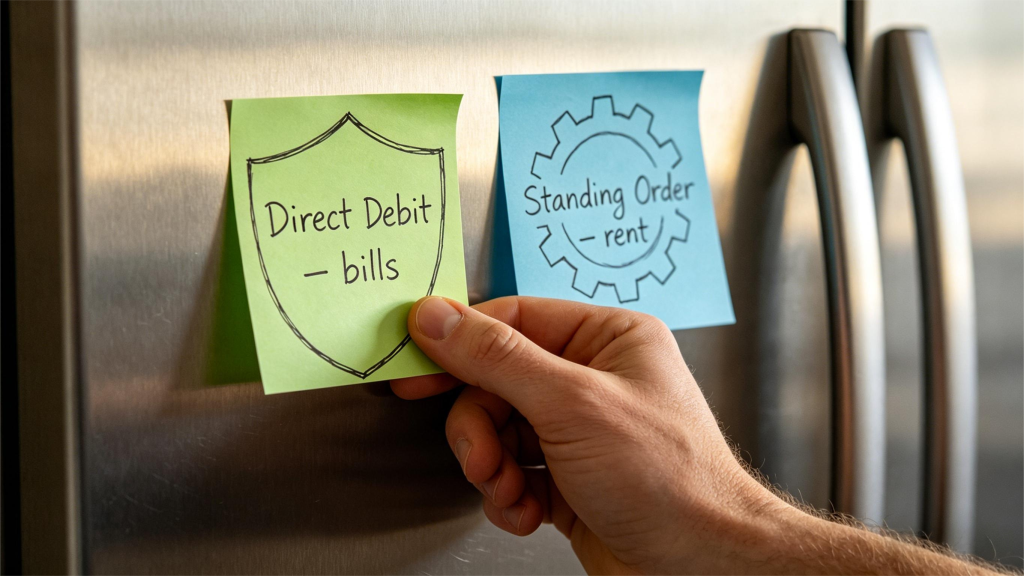
| Best for | Bills that vary (utilities) | Fixed, regular payments |
When to Use a Direct Debit
Direct Debits are the right choice when the amount you owe changes each month. Utility bills are the classic example: your electricity usage varies by season, so the exact amount is unpredictable. The billing company calculates what you owe and collects that precise amount.
Direct Debits also offer convenience for fixed amounts because of the protection. Many people pay their council tax by Direct Debit even though the amount is fixed – the guarantee means they can reclaim the money if the council makes a mistake.
Advantages of Direct Debits:
- You never need to remember to pay – the company pulls the money.
- If the company takes too much, the bank refunds you immediately.
- Many companies offer discounts for paying by Direct Debit (e.g., cheaper car insurance or broadband).
Disadvantages:
- You must trust the billing company to take the correct amount.
- Cancelling can be slightly more involved (you may need to contact both the company and your bank).
When to Use a Standing Order
Standing orders work best for payments that are the same amount every time and where the recipient is an individual (not a large company). Paying rent to a private landlord is the most common example. Landlords typically prefer standing orders because the amount is fixed and they do not need to request payment each month.
Advantages of standing orders:
- You are fully in control – the amount never changes without your action.
- Easy to set up and cancel through your banking app.
- No risk of a company taking an unexpected amount.
- Ideal for transfers between your own accounts (e.g., monthly transfer to savings).
Disadvantages:
- No protection if you make a mistake.
- If the amount needs to change (e.g., rent increase), you must manually update the standing order.
- The recipient cannot trigger a payment if you forget to fund the account – the payment simply fails.
Managing Both Effectively
Most people need both payment methods. A healthy system looks like this:
Use Direct Debits for:
- All household bills (council tax, utilities, broadband, insurance)
- Credit card payments (at least the minimum)
- Subscriptions you intend to keep
Use standing orders for:
- Rent to a private landlord
- Regular transfers to savings accounts (pay yourself first)
- Fixed charitable donations
- Payments to family members
Keep a bills account: Many financially organised people maintain a separate current account used exclusively for Direct Debits and standing orders. They calculate their total monthly bills, add a small buffer (e.g., £50), and transfer that amount from their main account each month. This ensures bill payments never fail due to accidentally spending the money elsewhere.
How to Cancel or Change Payments
Cancelling a Direct Debit: You can cancel through your banking app or by contacting your bank. However, you should also notify the billing company – otherwise they might think you have stopped paying and take collection actions (late fees, debt collection). Under the Direct Debit Guarantee, your bank must stop all future payments once you instruct them.
Cancelling a standing order: You simply delete the standing order in your banking app. No need to notify the recipient, though it is polite to do so. The recipient will see that future payments stop.
Changing a Direct Debit amount: You do not change it – the billing company does. If you think the amount is wrong, contact the billing company first. If they do not resolve it, ask your bank to refund the payment under the Direct Debit Guarantee.
Changing a standing order amount: You edit the standing order in your banking app. The recipient will receive the new amount on the next scheduled date.
Key Takeaways
- Direct Debits for variable bills – utilities, council tax, insurance – with full protection.
- Standing orders for fixed payments – rent, savings transfers, family payments – with your full control.
- Direct Debit Guarantee protects you – your bank must refund errors immediately.
- Standing orders have no protection – double-check amounts and recipient details.
- Consider a separate bills account – protect your main spending account from failed payments.
This article is for general information and educational purposes only. It does not constitute financial advice. Tax rules, allowances, and product terms may change. Always check with HMRC or an FCA-authorised adviser for your personal circumstances.